How to recognize a real Aleppo soap?
Aleppo soap is a product frequently counterfeited. How many people have bought Aleppo soap believing they were buying a quality product, only to find it was actually of poor quality? The answer is: far too many. Here are some tips to avoid being ripped off by dishonest manufacturers. 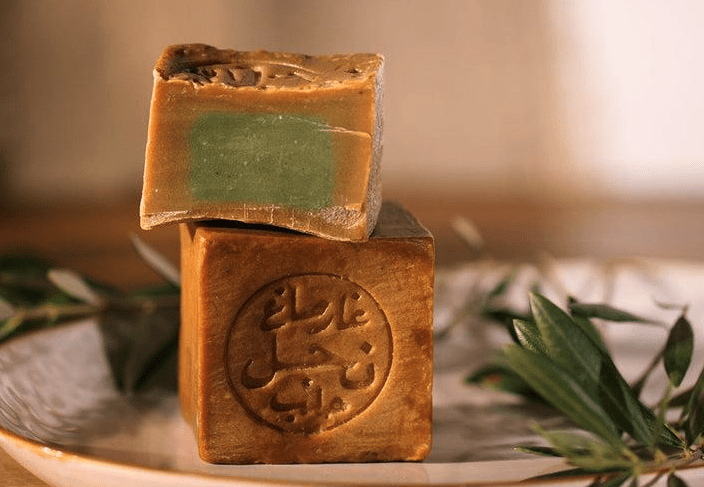
Aleppo soap and Camembert:
same battle?
What do Aleppo soap and Camembert cheese have in common? Neither product has a Protected Designation of Origin (PDO). Consequently, anyone can use the name “Aleppo soap” for products that have nothing to do with the original. That’s the crux of the problem. I’m going to give you some tips to separate the wheat from the chaff.
1) The origin
As its name suggests, true Aleppo soap must be made in the ancient city of Aleppo. There, a unique expertise is practiced that cannot be found anywhere else. A good way to identify it is the presence of a seal written in Arabic on the soaps. Each master soap maker has their own seal.
2) The color, the smell, and the appearance
Aleppo soap is easily recognizable by its unique appearance, a true mark of authenticity. On the outside, it ranges from light to dark brown, a color that naturally deepens over time as it dries. However, when the soap is cut, its interior reveals a characteristic green hue, due to the presence of olive oil and laurel berry oil.

Its exterior is intentionally rough and irregular: this is a handcrafted soap, traditionally cut by hand by the master soap maker. This uneven finish is therefore a sign of authentic production, not a defect.

Finally, its natural, slightly pungent, and vegetal scent is typical. The scented Aleppo soaps found in stores do not adhere to the traditional recipe and cannot be considered authentic.
3) The list of ingredients
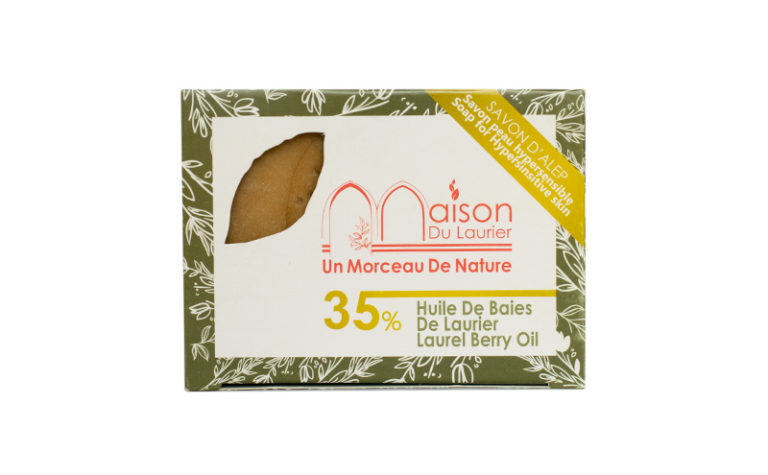
Aleppo soap has a very simple composition. The ingredients should be: olive oil, laurel berry oil, water, and soda. Often, unscrupulous manufacturers replace these precious ingredients with cheaper palm or coconut oil. So, be vigilant. The concentration of laurel berry oil varies between 5% and 55%, depending on the desired benefits.
Pay attention to the ingredients. A low-quality soap can have harmful consequences for your skin. If the soap contains animal fats, you won’t benefit from the purifying and moisturizing qualities of Aleppo soap. On the contrary, the fat will clog your pores. Even worse, some additives can cause irritation and allergic reactions.
4) Buoyancy
Although this criterion is difficult to test in store or on the Internet, an authentic Aleppo soap should float.
5) The price
If you see Aleppo soap with an unusually low price, be wary: there's a catch. To give you an idea, a standard soap with 3–5% laurel berry oil costs around 4 to 5 euros. Yes, quality comes at a price. Now you know how to spot genuine Aleppo soap from fake at a glance. So, what are you waiting for to enjoy its many benefits?
Latest articles
Is Aleppo Soap Really Antibacterial? What the Science Actually Says
You’ll often read that Aleppo soap is "antiseptic" or "antibacterial" thanks to its laurel berry oil. That reputation goes back centuries, and it didn’t come[...]
Tight, Uncomfortable Skin in Winter: Which Aleppo Soap to Use When the Cold Sets In
Every year, the same pattern. The first cold days arrive, the heating comes on, and skin starts to feel tight after a shower. Arms itch,[...]
Aleppo Soap: Why Laurel Berry Oil Is Not Laurel Seed Oil
Aleppo soap labels almost always say “laurel oil.” The word is the same everywhere, but it covers two very different ingredients, and only one of[...]